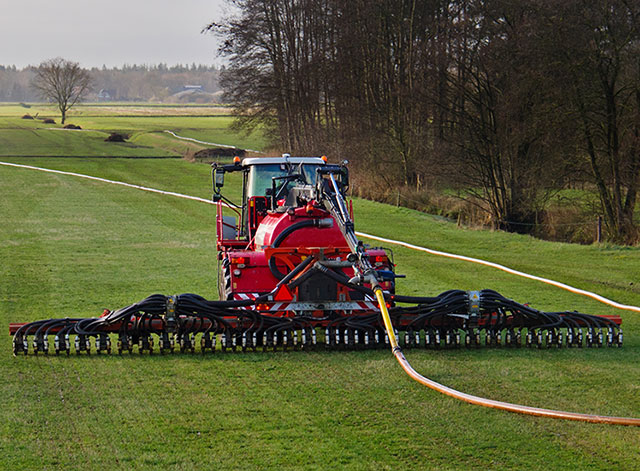
As slurry pits present a potential hazard to people, vehicles, and livestock, erecting barriers or fences can prevent fatal incidents. With children and the drivers of scraper tractors at a higher risk of falling in, having clear signs and deterrents alongside your barriers can help keep people safe.
Slurry Storage
Store slurry efficiently with durable, farm-ready storage systems
- Slurry tanks, slurry pits and lagoons, slurry store covers and slurry mixers designed to suit your farm’s requirements
- Durable, cost-effective systems built for long-term performance
- Supports efficient slurry management, nutrient retention, and environmental compliance
Already know what type of slurry storage you need? Fill out the form and speak with our team today.
Enquire About Our Slurry Storage
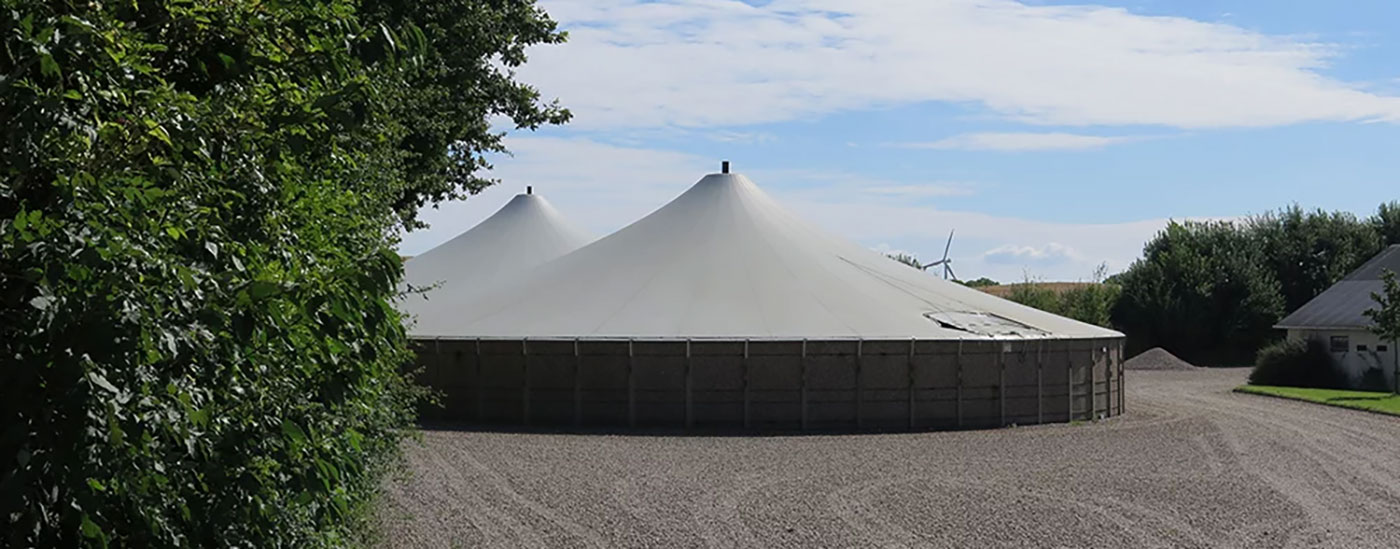
What is Slurry Storage?
Whether your farm has acres or hectares of land, if you have a hundred head of cattle or thousands, a slurry store is likely an integral part of your farm. Knowing which type of store you need can be difficult, particularly when every farm needs a different slurry store solution.
Available in various shapes and sizes, slurry stores are often adapted to meet the farmer’s needs, but they all essentially function in the same way. A slurry pit is a storage structure used to collect and contain slurry – a mixture of animal manure, water, and organic waste such as straw – until it can be spread or injected onto fields as nutrient-rich fertiliser.
Our Slurry Tanks
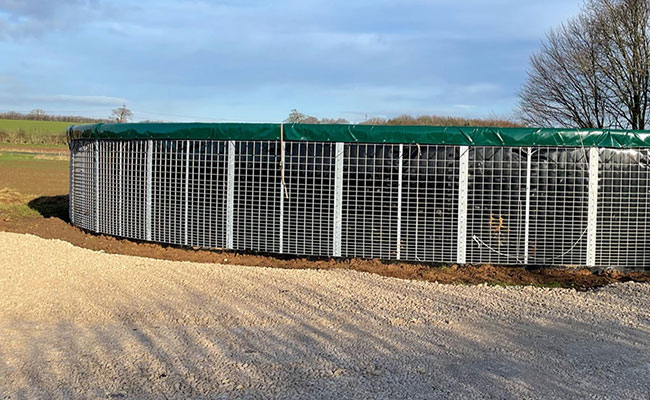
Steel Mesh Tanks
Need a simple storage solution for your digestate and slurry? Quick, flexible and versatile, our steel mesh silage tank is perfect for smaller slurry amounts or as satellite storage on multiple sites. Find out more here or get in touch with the team.
Steel Panel Slurry Tank
Need a larger slurry storage solution? Made from galvanised steel panels bolted together on-site, our steel panel slurry tanks provide durable, high-capacity storage for slurry and digestate. Available in a range of sizes and configurations, they’re ideal for farms requiring larger storage volumes and can be fitted with covers to help maximise storage capacity.
Our Slurry Pits & Lagoons
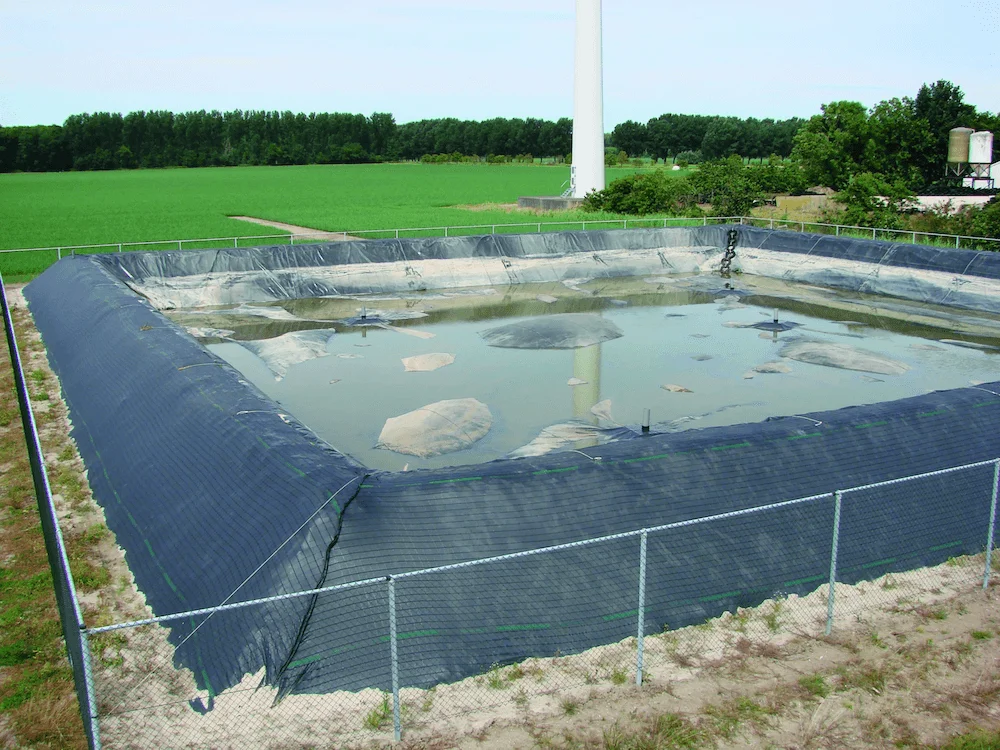
Slurry pits and lagoons provide a practical storage solution for farms requiring larger storage volumes or where below-ground storage is better suited to the site layout. Designed to safely contain slurry until it can be applied to land, these systems help farms meet storage requirements while retaining valuable nutrients for crop production.
Available in a range of sizes and configurations, slurry pits and lagoons can be tailored to suit your farm’s capacity requirements, ground conditions, and future growth plans. They may be built below ground, or used alongside slurry tanks and slurry lagoons as part of a wider slurry storage system. These solutions help farms manage excess waste efficiently while retaining valuable nutrients such as nitrogen, phosphorus, and potassium, which are essential for healthy crop growth.
Our team can help you identify the most suitable solution to ensure efficient slurry management and long-term compliance.
Which Slurry Storage Solution Is Right for Your Farm?
Choosing the right slurry storage system depends on your farm size, storage requirements, available space, rainfall, yard runoff, soil conditions, water table, available land and long-term operational goals.
Steel mesh slurry tanks, reception slurry pits, earth-banked lagoons and then the necessary slurry store covers all offer different benefits in terms of capacity, installation, access, flexibility and nutrient management.
Use the comparison table below to explore the most suitable slurry storage options for your farm and find the right balance between efficiency, compliance, and cost-effectiveness.
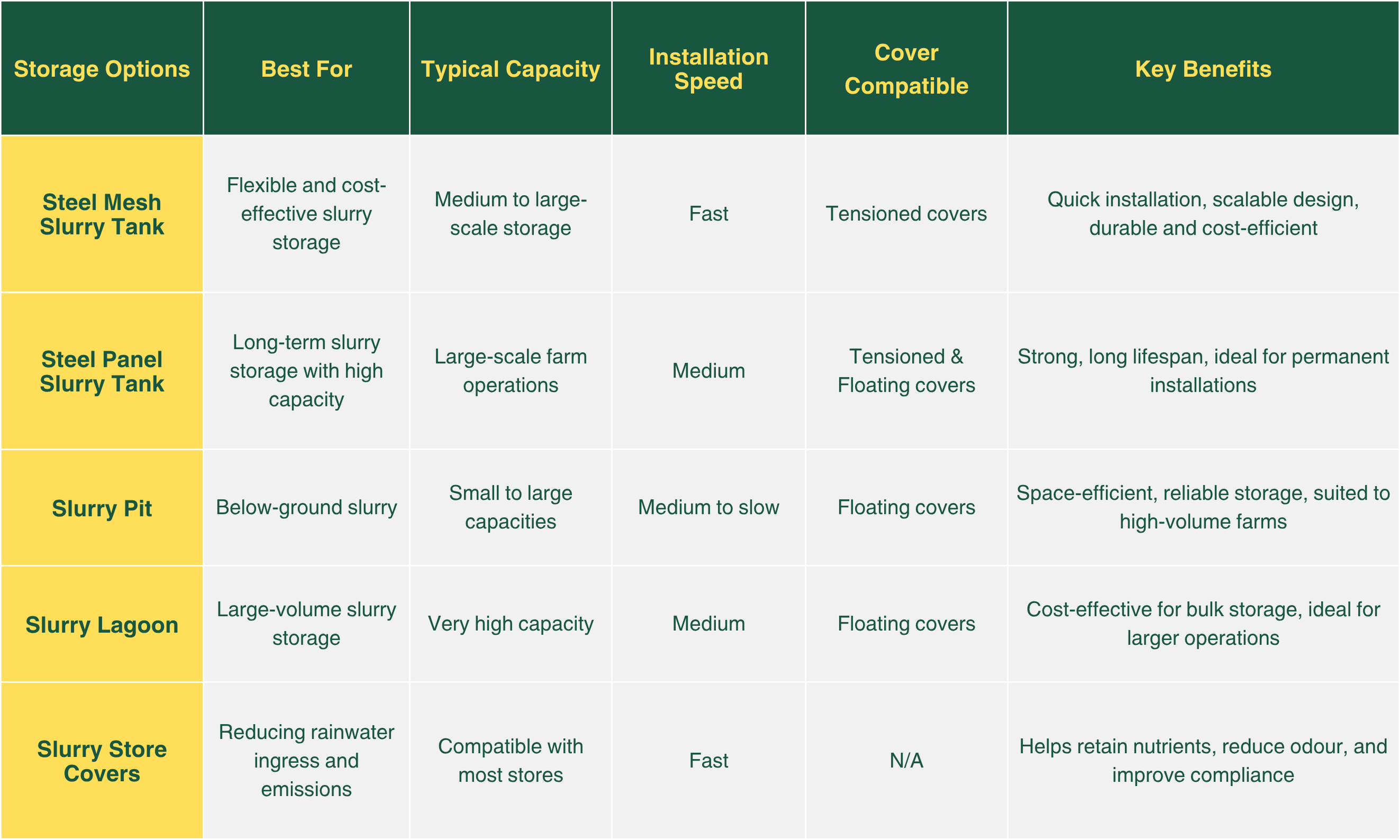
Still unsure? Discuss your slurry storage requirements with AWSM today.
Underground or Above Ground Storage?
Broadly speaking, underground slurry storage tanks tend to be cheaper than their above-ground equivalents. However, both have their merits, and it’s always worth exploring your options in full to find the best solution for you and your farm.
Underground Slurry Storage
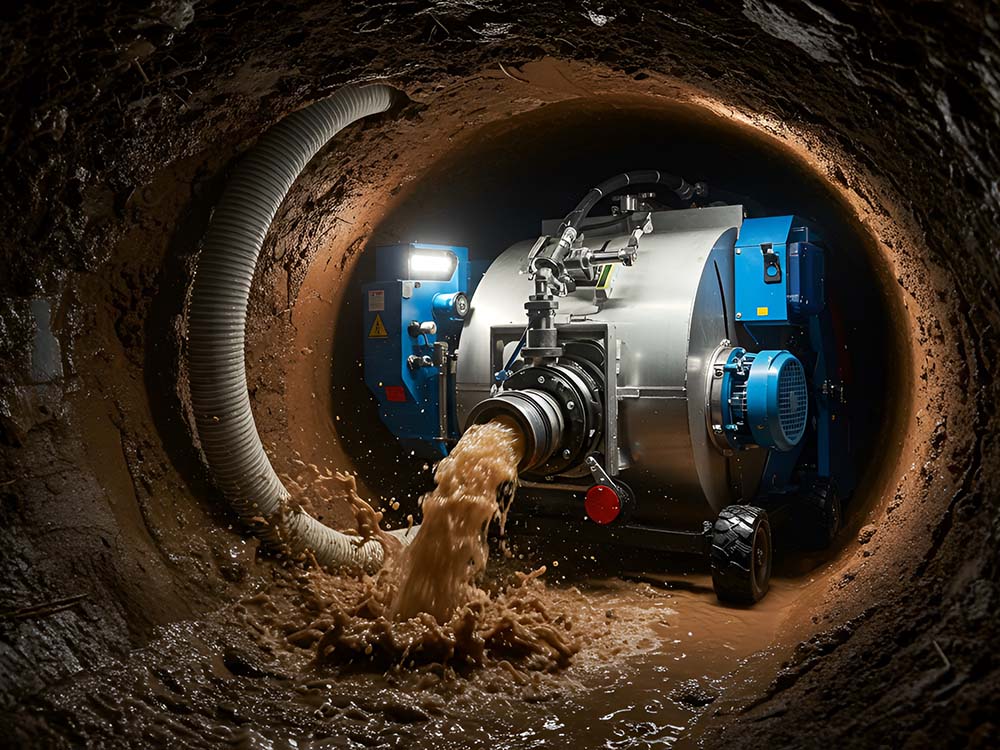
Underground slurry tanks are ideal for farms looking to maximise storage capacity while minimising the amount of surface space used. Built using prefabricated systems and available in a range of sizes, underground storage offers a practical solution for efficient slurry management.
Benefits
- Takes up less ground space
- Often lower installation costs
- Quick installation using prefabricated systems
- Flexible sizing for different farm requirements
- Reduced visual impact
Considerations
- Deeper tanks may require stronger pumping systems
- Excavation can increase installation complexity
- Maintenance access may be more limited
Above-Ground Slurry Storage
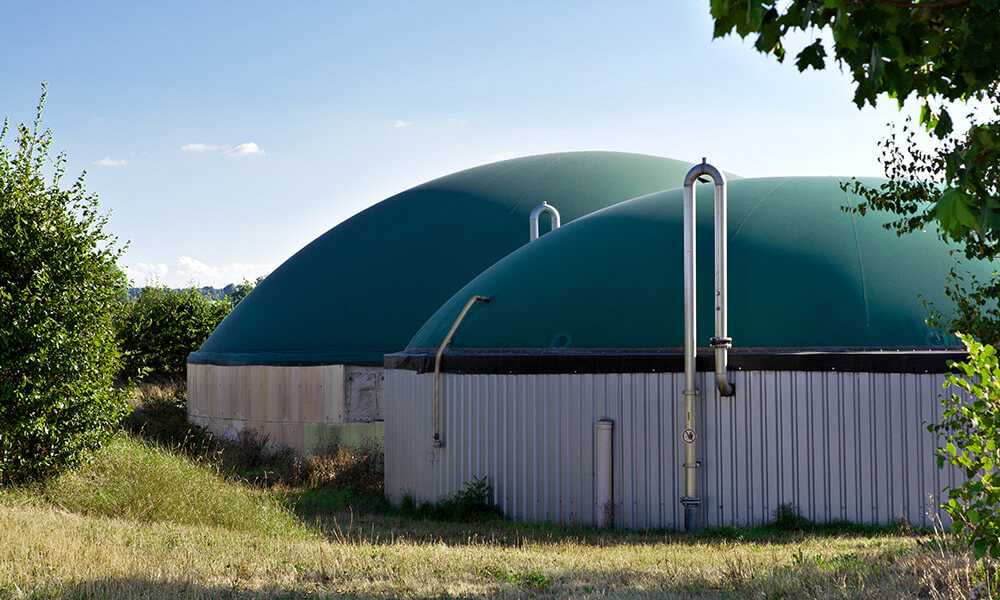
Above-ground slurry tanks are a flexible and scalable option, particularly suited to farms with high water tables or limited excavation potential. They are easier to expand over time and can be covered more cost-effectively to help reduce overflow risk and nutrient loss.
Benefits
- Easy to expand as storage needs grow
- Suitable for high water table areas
- Easier and more affordable to cover
- Simple access for inspection and maintenance
- Durable long-term storage solution
Considerations
- Requires more surface space
- May require reception pits and transfer pumps
- Greater visual impact on-site
How Much Slurry Storage Do I Need?
Choosing the right slurry storage capacity is essential for keeping your farm efficient, compliant, and prepared for changing weather conditions. Your storage requirements will depend on factors such as herd size, rainfall, wash water, housing periods, and whether your farm is located within a Nitrate Vulnerable Zone (NVZ).
Current UK guidance recommends farms should typically have at least four months of slurry storage capacity, with additional allowances for rainfall and freeboard:
- 300mm freeboard for steel and concrete slurry stores
- 750mm freeboard for earth-banked slurry lagoons
If your farm experiences high rainfall or extended closed spreading periods, you may need additional storage capacity to safely manage slurry throughout the year.
Investing in the right slurry tank, slurry pit, or slurry lagoon helps protect against overflow risks, improves nutrient management, and gives you greater flexibility when spreading conditions are right.
How To Calculate Slurry Storage
Calculating slurry storage starts with one key question: how much slurry does your farm produce during the housing period?
A reliable slurry storage calculation should factor in:
- Herd size and livestock type
- Slurry produced during housing
- Rainfall and dirty water runoff
- Parlour washings and yard water
- Freeboard requirements
- NVZ regulations and spreading restrictions
It’s not just about meeting minimum requirements – it’s about making sure your farm has the storage capacity needed to operate efficiently year-round.
Too much to consider when calculating your slurry storage requirements? Don’t worry! We can help do the hard work, ensuring your storage capacity is accurately calculated for your farm’s size, layout, and future growth plans!
What is the purpose of slurry storage in farming?
Slurry storage is essential for the proper management of your farm’s operations. Properly storing the valuable mixture of animal waste and water, which contains crucial nutrients such as nitrogen and phosphorus, helps to increase crop yields, improve soil health and reduce the need for synthetic fertilisers.
What are the potential risks associated with improper slurry storage?
Improper slurry storage can pose several risks to your farm operations, as well as to the environment and community health as a result of spills, leaks, and odours. Inefficient slurry storage systems can contribute to surface and groundwater pollution, as well as releasing greenhouse gases like methane and nitrous oxide into the atmosphere – which are potent contributors to climate change. Similarly, uncovered or inadequately covered slurry tanks and pits can emit unpleasant smells that may be a nuisance to residents who live nearby, leading to complaints and regulatory issues. However, with proper slurry storage practices, the impacts can be minimised and you’ll be well on your way to running an efficient, profitable and productive farm.
How to fill a slurry tanker?
Filling a slurry tanker requires you to have a standing body of slurry, whether in a lagoon, above-ground store or in an underground storage tank. Slurry tankers come with fitted pumps which allow you to suck slurry directly into the tank before transporting it. Slurry reception pits can also be used to collect slurry from your storage tank before being pumped into the tanker.
How much does a slurry store cost?
The cost of a slurry store varies greatly depending on the style and size of the store. As with most things, the larger the store, the higher the cost will be. Some stores are more expensive than others, with underground and lagoon stores being the cheapest and overground tankers costing the most.
Do slurry pits require barriers?
How does efficient slurry storage contribute to sustainable farming practices?
Well, where do we begin? Slurry has the potential to wreak havoc on our environment, whether that be from spillages or harmful gases escaping. However, by ensuring you have effective slurry storage in place, including slurry pit liners and slurry store covers, you’ll be doing your part to contribute to sustainable crop production and land use. Reducing your carbon footprint by trapping in greenhouse gases, as well as preventing harmful spills into the surrounding environment, you’ll make the right investment for the future of your farm and our planet.